
Pflugerville Epoxy Flooring provides polished concrete flooring across Pflugerville, TX and the surrounding cities including Wells Branch, Round Rock, Manor, Hutto and Brushy Creek, and after more than 20 years running grinders on Central Texas slabs we can usually tell you within a few passes what a floor is going to look like.
Polishing is the one flooring service on this site that installs nothing. There is no film, no resin and no color added; the finish is the concrete you already own, cut and refined until it reflects. That makes it the most durable floor we offer, because there is no coating to delaminate, and also the least forgiving, because whatever is in your slab is what you get.
Which is why we look before we promise. Aggregate size and distribution, surface hardness, how flat the pour is, what is buried in it and whether anything was ever glued or coated onto it all decide the honest range of outcomes. We would rather show you a test patch on your own floor than a photograph of somebody else’s.
How Concrete Polishing Actually Works
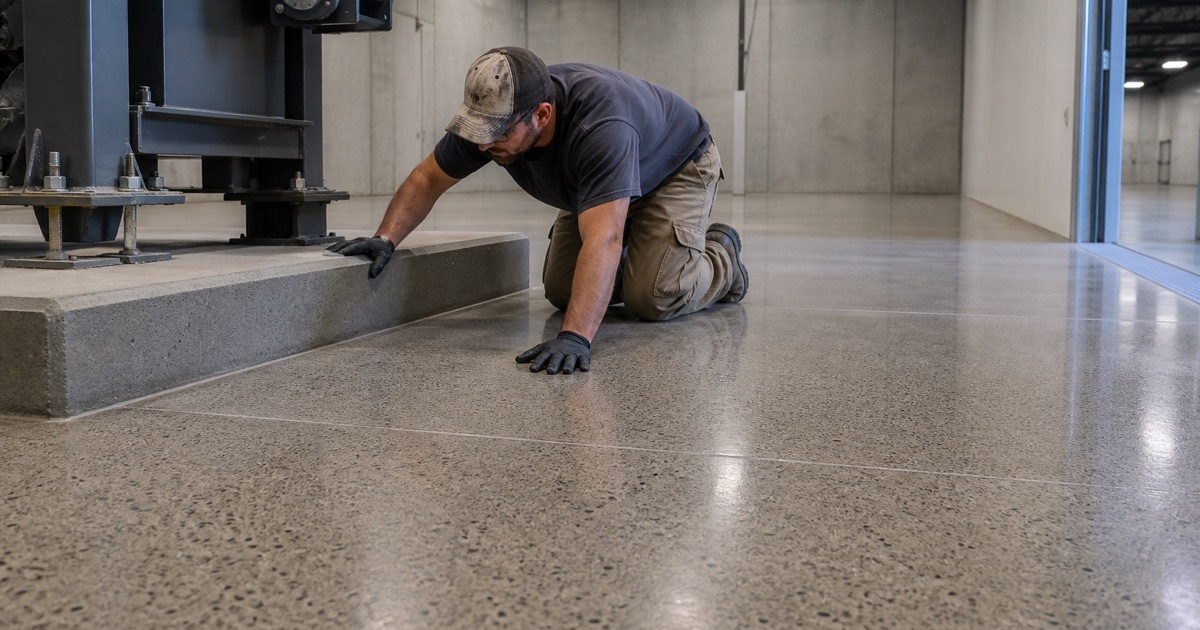
The Grit Progression, From Cutting to Refining
Polishing runs as a sequence of diamond passes, each one removing the scratch pattern left by the last. Metal-bond diamonds do the cutting at the coarse end, opening the surface and flattening it, then resin-bond diamonds take over and refine through progressively finer grits until the surface reflects rather than scatters light. Skipping a step is the classic shortcut and it is visible forever, because a fine pass cannot remove a coarse scratch, it can only polish the edges of it.
Lithium Silicate Densifier and Why Timing Matters
Partway through the progression we apply a lithium silicate densifier, which penetrates and reacts with free lime in the cement paste to form additional binder inside the top few millimeters. That is what makes a polished floor hard enough to resist abrasion and tight enough to resist staining. Applied too early it seals a surface that still needs cutting; applied too late it cannot penetrate. Where in the sequence it goes depends on the concrete, which is another reason the slab gets read first.
Cream, Salt-and-Pepper and Full Aggregate Exposure
How deep the first cut goes decides what the floor shows. A cream finish stays in the cement paste and reads as a soft, uniform surface, a salt-and-pepper cut goes just past it to reveal fine sand as flecks, and a full exposure removes enough material to show the coarse stone and reads almost like terrazzo. That decision is made in the very first pass and cannot be revisited, so we make it deliberately with you, on your own slab, before the machine starts.
Commercial Polished Concrete Flooring
Retail, Showroom and Office Floors
Commercial interiors take polished concrete for the reason facility managers care about: the floor is the structure, so there is nothing to replace on a cycle. A polished slab under retail traffic needs periodic burnishing and a reapplication of guard rather than a tear-out, and it does not outgas or delaminate. We coordinate around trading hours and phase the work by section where the space cannot close.
Warehouse Floors and Joint Treatment Under Wheeled Traffic
In a warehouse the polishing is the easy half. Joints are what fail, because a hard wheel crossing an unsupported joint edge spalls it, and once an edge starts breaking down it accelerates. We fill joints with a semi-rigid polyurea that supports both edges under load and finish the filler flush with the polished surface, so the wheel rolls across rather than dropping into a gap.
Maintenance Cost Over the Life of the Floor
The argument for polished concrete in a commercial building is rarely the install price, it is the decade afterward. There is no stripping, no waxing and no recoating schedule, and cleaning is a neutral cleaner and an autoscrubber. We are straightforward that the front-end cost of a full-exposure polish on a difficult slab can exceed a coating; the case for it is made over years, not on the first invoice.
Residential Polished Concrete Flooring
Interior Living Slabs and Slab-on-Grade Homes
In a house, polished concrete works best where the slab was always meant to be finished flooring, or where tile or carpet is coming out anyway. We grind off adhesive, thinset and old finishes, assess what is underneath, then agree the exposure. Slab-on-grade construction dominates this region, which means the material is already there under most floor coverings in the house.
Polished Garages and Shop Floors
A polished garage floor is a real alternative to a coating, and it is the right call when the slab is sound and you want a surface that cannot peel. It shows tire marks more readily than a flake floor and it will not hide a rough pour, so we are candid about which slabs suit it. Where the concrete is patchy, a coated system is usually the better outcome.
What a Production-Built Tract Slab Will Actually Yield
Most homes across this service area are relatively recent tract construction, and those slabs were poured to be covered rather than displayed. Expect a shallower exposure, more visible pour lines and the occasional embedded flaw, because the aggregate near the surface was never selected to be seen. We take a test patch in an inconspicuous corner and let the actual slab set the expectation rather than a brochure.
What Decides Whether Your Slab Can Be Polished
Flatness, Pour Lines and How Far the Grinder Has to Go
A grinder follows the plane of the floor it rides on, so a slab with a dip or a crown polishes unevenly unless enough material comes off to flatten it, and every extra pass costs money. We check flatness with a straightedge across the whole area before quoting, because the difference between a level pour and a wavy one is the difference between three passes and seven.
Surface Hardness and Diamond Bond Selection
Concrete hardness varies enormously between pours and even within one slab. Diamond segment bond hardness has to be matched inversely to it, with soft bonds on hard concrete so the diamonds keep exposing, and hard bonds on soft concrete so they do not wear away. Getting that wrong wastes tooling and leaves a scratch pattern that will not refine out, which is why we bring more than one bond to a first day.
Existing Coatings, Adhesives and Moisture in the Slab
Anything on the slab comes off first. Old coatings, mastic and carpet adhesive are removed with PCD tooling before diamonds ever touch the concrete, because adhesive loads and glazes polishing tooling immediately. We also test moisture: polished concrete is breathable and tolerates vapor far better than a film does, but a slab moving serious moisture can still show efflorescence and darkening at the surface, and you should know that before rather than after.
- 20+ Years in Central Texas
- Insured & Workers Comp Covered
- Free Written Estimates