
Pflugerville Epoxy Flooring installs flake epoxy floor systems throughout Pflugerville, TX and the surrounding cities including Wells Branch, Round Rock, Manor, Hutto and Brushy Creek. It is the system we install most often here, and in more than 20 years it has proven to be the best all-round answer for a floor that has to look good, hide the realities of daily use, and grip when something gets spilled on it.
A flake floor is built rather than painted. A pigmented base coat goes onto a properly ground slab, vinyl chip is broadcast into it while it is wet, and clear topcoats lock the chip in and fill the surface between the pieces. The finished floor has real thickness, a subtle texture, and a visual pattern that makes dust, tire marks and the ordinary scuffs of a working space almost invisible.
Nearly every decision that changes how it looks and performs is made before we open a pail: chip size, color blend, broadcast rate, topcoat chemistry and sheen. This page covers each of those, and what they mean in practice on a Central Texas garage, shop or commercial floor.
Chip, Blend and Broadcast
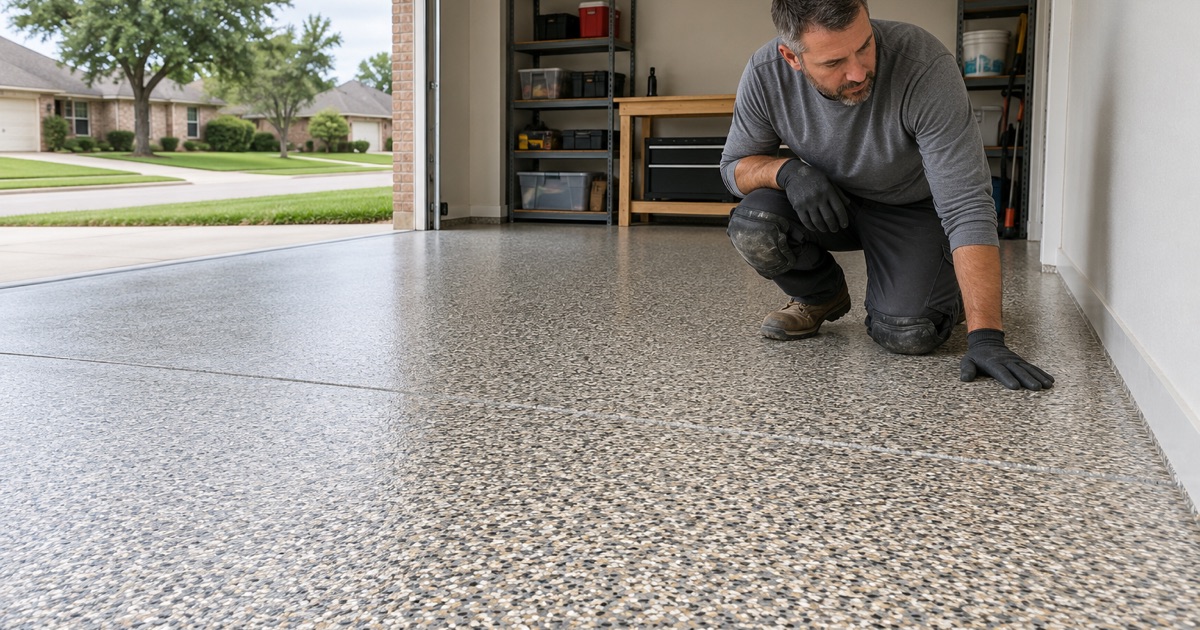
Chip Size and How Busy the Floor Reads
Vinyl chip comes in a range of sizes, and size changes the character of the floor more than color does. A quarter-inch chip reads as fine texture across a room, almost like stone, a half-inch chip reads as a clear pattern, and a one-inch chip is a bold architectural look that suits a large open area while overwhelming a small one. We put physical samples in the actual space rather than judging from a chart, because scale is entirely relative to the room it sits in.
Color Blends and Base Coat Interaction
Blends are mixtures of several chip colors, and standard blends are engineered so the combination reads as one coherent tone from standing height. The base coat underneath still matters, because at anything less than a full broadcast the base shows through the gaps and shifts the overall tone. We select base and blend together, and where a specific color is wanted we can build a custom blend rather than settling for the nearest standard one.
Broadcast Rate, From Partial to Full Refusal
Broadcast rate is how much chip goes into the wet base coat, and it is a real specification rather than a detail. A partial broadcast leaves the base color visible between the chips for a speckled effect and uses less material. A full broadcast to refusal covers the base entirely, which is what most of our garage and commercial floors get: it builds more thickness, provides more texture, and gives the most consistent appearance across a large area.
Building the System
Base Coat, Broadcast and the Timing Between Them
The chip has to land in the base coat while it is still wet enough to accept and hold it, so broadcast follows the base coat immediately and continuously across the area. On a warm slab that working window is short, which is why we mix in half batches with a dedicated mixer and enough people to place and broadcast each one within it. A section that has begun to set before the chip lands will shed it later.
Scraping, Vacuuming and the Clear Coats
Once cured, the excess chip that did not embed is scraped off and vacuumed, which is what turns a rough, spiky surface into a comfortable one. Then the clear topcoats go on, usually two, filling the space between chips and building the wear layer. How much clear goes on decides both durability and how smooth the floor feels underfoot, and it is one of the easiest places for a cheap installation to cut corners invisibly.
Topcoat Chemistry and Sheen
We generally finish with a polyaspartic or polyurea clear rather than an epoxy one. Epoxy is not ultraviolet stable and will amber where daylight reaches it, which is very obvious on a light blend and unimportant on a dark one. Sheen is chosen at the same time: gloss looks deepest and shows dust, satin keeps most of the depth with far less upkeep, and satin is what we recommend for a garage that is actually used.
Living With a Flake Floor
Traction, Comfort and Cleaning
The scraped and cleared flake surface has a fine, even texture that grips underfoot when wet without feeling rough, which is why it suits garages, laundry rooms, patios and commercial back-of-house areas equally well. Cleaning is a dust mop and a neutral cleaner. Where more grip is required, a fine aggregate can be added into the final clear, and that decision belongs at the quote rather than afterward.
Hiding Wear, and What It Will Not Hide
The visual noise of a flake blend is remarkably effective at concealing dust, tire marks, fine scratching and the general evidence of a floor being used, which is the main practical reason we recommend it over a solid color in a working space. What it will not hide is a slab that moves: a crack telegraphing up through the system shows as a line regardless of what pattern is above it, which is why crack detail happens before any of this.
Repairs and Recoating Over Time
A flake floor ages well and repairs well. A damaged area can be ground out, rebuilt with matching chip and re-cleared, and because the pattern is a random broadcast rather than a formed design the repair genuinely disappears in a way a metallic repair cannot. When the clear eventually dulls in traffic lanes it is abraded and re-cleared in a day, leaving the base and chip untouched.
- 20+ Years in Central Texas
- Insured & Workers Comp Covered
- Free Written Estimates