
Pflugerville Epoxy Flooring installs concrete driveway coating systems in Pflugerville, TX and the surrounding cities including Wells Branch, Round Rock, Manor, Hutto and Brushy Creek. Twenty years of exterior concrete work here means we approach a driveway with more caution than a garage, because a driveway is the hardest surface on any property to coat successfully and the easiest one to get wrong.
Everything that makes a driveway difficult happens outside. It is in full sun all day, it is exposed to rain and to freeze events, it carries vehicle weight and turning tires, it has no roof over its expansion joints, and it sits on the same reactive ground that moves the rest of the property. A product that performs indefinitely inside a garage can fail on a driveway within a couple of seasons.
That does not mean it cannot be done well, and we do it regularly. It means the specification is narrower, the preparation matters more, and the honest conversation about which driveways are good candidates has to happen before you spend anything. Below is how we assess yours and what we would put on it.
Whether Your Driveway Is a Good Candidate
Slab Condition, Cracking and Movement
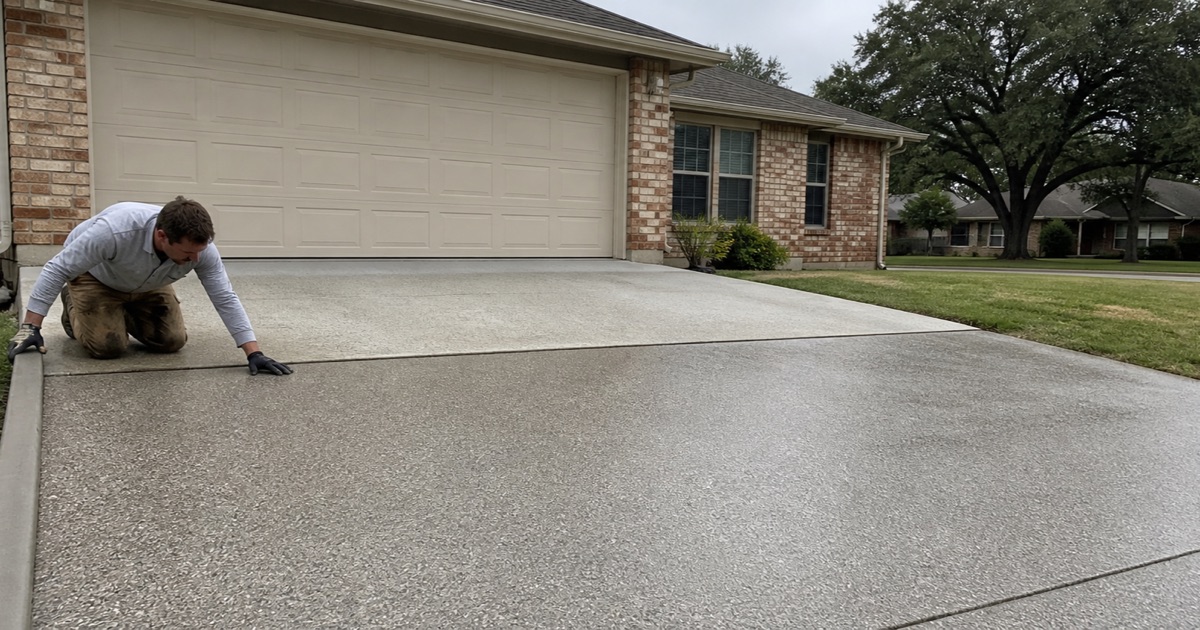
We start by walking the driveway and reading its cracks. Fine surface cracking and a few settled lines are normal and workable. Wide cracks with vertical offset between the two sides, sections that rock underfoot, or a slab that has visibly heaved are telling you the ground beneath is moving, and no coating installed on top of that survives. Where that is what we find, we say so and recommend against coating rather than selling you a surface that will tear.
Age, Surface Soundness and Prior Sealers
The concrete surface itself has to be sound and open. A driveway that is spalling, scaling or dusting has a weak top layer, and anything bonded to it is bonded to the part that is coming off, so that gets resurfaced first or not coated at all. Most driveways also carry a sealer or a curing compound, sometimes several applications over the years, and all of it has to be mechanically removed before we begin.
Drainage and Where the Water Goes
A driveway is a drainage structure whether or not anyone designed it as one, and a coating must not change the direction water runs. We check falls before quoting, look at where water leaves at the apron and at the garage threshold, and detail the edges so the coating terminates cleanly rather than letting water track underneath it. Water getting beneath a coating at an unsealed edge is one of the more common ways an exterior floor starts lifting.
Systems for an Exterior Slab
UV-Stable Topcoats, and Why Epoxy Never Goes on Top Outside
Epoxy is not ultraviolet stable. In direct sun it ambers, chalks and loses gloss, and on a driveway that process is fast and completely visible. So while an epoxy can be part of the build underneath, the surface layer is always a polyaspartic or polyurea formulated to hold its color. Anyone offering a straight epoxy driveway coating is offering you a floor that will look tired in one Texas summer.
Broadcast Texture and Wet Traction
A driveway is wet regularly and it is where people step out of a car, so traction is a safety specification. We build exterior systems with a broadcast aggregate, sized to grip a wet shoe without being so coarse that it traps dirt and becomes impossible to clean. A smooth, glossy exterior coating looks impressive in a photograph and is genuinely hazardous the first time it rains.
Decorative Overlays as an Alternative
Where the goal is appearance rather than a resin wear surface, a polymer-modified cementitious overlay is often the better exterior choice. It can be stamped, stenciled, scored or broomed, takes integral color, breathes rather than sealing the slab, and is more tolerant of vapor moving up from the ground. We will put both options in front of you when a driveway suits either, with the tradeoffs written out.
Preparation, Joints and Working Outdoors
Mechanical Preparation on an Exterior Slab
The driveway is ground or shot blasted to an ICRI CSP profile and every sealer, coating and contaminant is removed first. Exterior slabs also collect oil at the parking spots and tire rubber in the wheel tracks, and both have to be degreased and mechanically removed rather than coated over. We do not acid etch anywhere, and on a driveway it is particularly pointless because it puts water into a slab that is already exposed to the ground.
Expansion Joints Carried Through the Coating
Every control and expansion joint in a driveway is there because the slab needs to move, and outdoors it moves more, since it swings through a much wider temperature range than an interior floor and sits on soil that changes with the season. We carry every joint through the finished surface and fill it with a flexible material. Coating solid across a joint is the fastest way to put a crack into a brand new driveway.
Slab Temperature and the Working Window
Exterior placement is scheduled around the slab rather than the calendar. A sun-loaded driveway passes the published application ceiling for most coatings well before the air temperature does, and early morning is closed off because dew point at the surface leaves the slab damp. In practice that means a mid-morning start, work finished before the afternoon heat loads the slab, and a genuine willingness to move the day when the forecast says to.
- 20+ Years in Central Texas
- Insured & Workers Comp Covered
- Free Written Estimates