Pflugerville Epoxy Flooring handles concrete resurfacing throughout Pflugerville, TX and the surrounding cities including Wells Branch, Round Rock, Manor, Hutto and Brushy Creek. Twenty years of work on slabs in this region means we have seen most of the ways concrete gives up at the surface, and we can usually tell a cosmetic problem from a structural one on the first visit.
Resurfacing means putting a new wearing surface onto a slab whose own surface is no longer sound. That is a different job from coating, and confusing the two is expensive. A coating is a thin film that relies entirely on the concrete beneath it; a resurfacer is a cementitious or polymer-modified layer with real thickness that replaces the top of the slab. If the top of your concrete is failing, a coating simply bonds itself to the part that is coming off.
So the first question we answer is whether your slab has a surface problem, a structural problem, or both. Spalling, delamination and scaling are surface conditions we can rebuild. Differential settlement, a slab broken across its depth, or heave from the clay underneath are structural conditions, and we will tell you plainly that those need addressing by a foundation contractor first, under their own permit, before any surface we install has a chance.
What We Resurface, and What We Do Not
Spalling, Scaling and Delaminated Surfaces
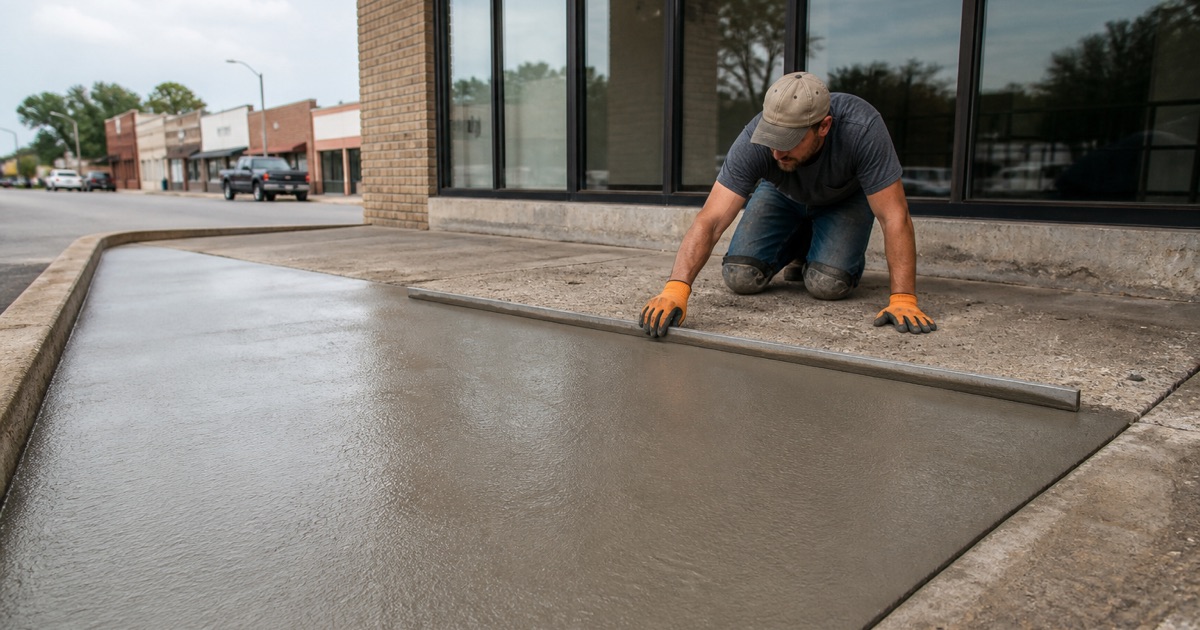
Spalling is concrete flaking away in patches, usually because the surface was overworked or finished with bleed water still rising, leaving a weak layer that eventually separates. Delamination is the same failure on a larger scale, where a whole skin lifts and sounds hollow underfoot. Both are surface conditions with sound concrete underneath, and both are exactly what resurfacing exists to fix. We sound the slab out with a chain or hammer to map the extent before quoting rather than guessing at a percentage.
Worn, Pitted and Trench-Damaged Industrial Slabs
Warehouse and shop floors wear unevenly. Wheel paths polish and then pit, forklift traffic rounds off joints, and plumbing or conduit trenches leave patches that never matched. Resurfacing gives the whole area one continuous new wearing surface at a consistent level rather than a floor that reads as a patchwork. We can build to a specified thickness and re-establish falls to drains at the same time.
Structural Cracking and Movement We Will Not Cover Over
Where a slab has broken through its depth, dropped at one side, or heaved, no surface product fixes it and any we installed would tear. Blackland clay is capable of moving a slab seasonally, and where that is what we are looking at we say so and stop. Foundation work is a structural alteration and carries its own permit, which a floor coating does not, and we would rather lose the job than sell a surface over a moving slab.
Resurfacing Systems and How We Choose Between Them
Polymer-Modified Cementitious Overlays
The workhorse for most slabs is a polymer-modified cement overlay, which bonds to properly prepared concrete and can be built from a skim to well over a quarter inch. It cures to a hard, dense surface that can be left as a broom or trowel finish, textured, or coated afterward. Because it is cement based it breathes, which matters on a slab-on-grade with vapor coming up through it.
Microtoppings and Skim Coats for Cosmetic Repair
Where the concrete is structurally fine but visually poor, a microtopping applied at a fraction of a millimeter to a couple of millimeters resets the appearance without adding meaningful height. That matters at door thresholds and against existing tile, where even a quarter inch changes how a door swings. Microtoppings can be integrally colored and are frequently the base for a decorative finish.
Epoxy Mortar and Deep Patch Repair
For localized deep damage, an epoxy or urethane mortar filled with graded aggregate rebuilds the section faster and stronger than cement will, and it will take traffic within hours rather than days. We use it at joint edges, spalled dock areas and equipment pads where the repair has to be tough and the space cannot be closed for long, and we feather it into the surrounding surface so it does not stand proud.
Surface Preparation, Which Is Most of the Job
Removing Everything Unsound Before Anything New Goes On
A resurfacer bonds to what it is put on, so anything loose has to go. We remove delaminated material back to solid concrete, cut out the perimeter of each repair square rather than feathering to a knife edge, and take off any coating, sealer or curing compound across the whole area. A repair feathered to nothing has no thickness at its edge and that edge is where it starts breaking away.
Mechanical Profile and the Bond That Depends on It
The prepared slab is profiled by diamond grinding or shot blasting to an ICRI CSP profile appropriate to the thickness being placed, which is a deeper profile than a thin coating needs. We do not acid etch. The bond between old concrete and new is entirely mechanical, so profile depth is not a detail we trade against schedule, and we vacuum the surface immediately before placement because dust is a bond breaker.
Moisture, Temperature and the Placement Window
Cementitious overlays need the substrate damp but not wet, while resinous mortars need it dry, so the two have opposite requirements and we plan for whichever is going down. We test with ASTM F1869 or ASTM F2170 where a coating will follow the resurfacer, since the finished floor is only as good as the vapor conditions underneath it. Placement is scheduled around slab temperature, because a hot slab shortens working time sharply and a cold one delays set.
After the Resurfacer: Finish Options
Coated, Sealed or Left as a Wearing Surface
A resurfaced slab can be left as its own finished surface with a broom or trowel texture, sealed for stain resistance, or used as the base for an epoxy or polyaspartic system. Which one you choose changes the finish we trowel into the overlay, so it is a decision we need before placement rather than after. A surface finished for coating and then left bare will look wrong, and the reverse is worse.
Color, Texture and Slip Resistance
Overlays take integral color and can be stamped, stenciled, broomed or sprayed to a texture. Outdoors and around water, texture is a safety specification rather than a style choice, and we set the coefficient of friction with the finish rather than hoping the sealer provides it. Indoors, a smoother trowel finish is easier to keep clean and is the usual choice under equipment.
Joints Carried Through the New Surface
Every control and construction joint in the slab beneath has to be carried up through the resurfacer at the same location, because the slab will keep moving at those lines whatever we place on top. We saw or tool them through and fill them with a flexible semi-rigid polyurea. Covering a joint solid is the single most reliable way to guarantee a crack in a brand new surface.
- 20+ Years in Central Texas
- Insured & Workers Comp Covered
- Free Written Estimates