
Pflugerville Epoxy Flooring installs metallic epoxy floor systems in Pflugerville, TX and the surrounding cities including Wells Branch, Round Rock, Manor, Hutto and Brushy Creek. In more than 20 years of resin flooring we have learned to treat metallic as the one system where the installation itself is the design, because the pattern is created while the material is still liquid and there is no second chance at it.
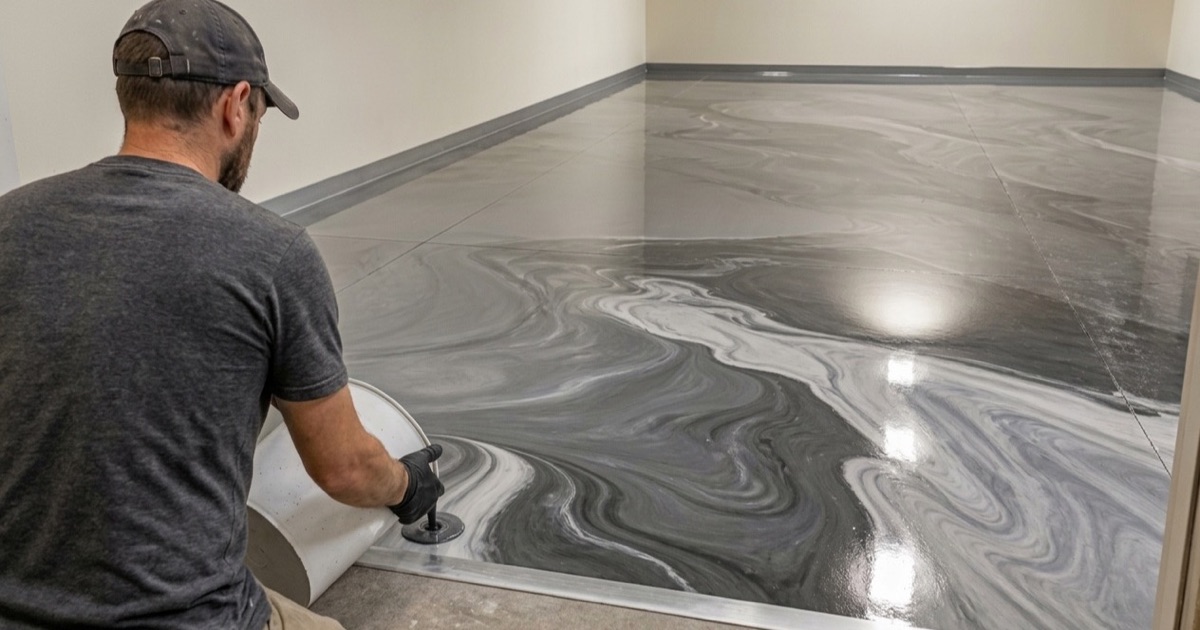
A metallic floor is metallic pigment suspended in a clear 100% solids epoxy. The pigment particles orient and migrate as the resin flows and as air moves across it, producing depth, movement and a marbled or pearlescent effect that no printed or pigmented product imitates. Two floors poured from the same kit look different, which is the appeal and also the reason a sample can only show you a character rather than a copy.
It is a demanding install and we are open about that. The slab has to be flat, the primer has to be right, the crew has to work continuously across the whole area, and every stop, seam and mis-timed pass is visible in the finished floor. Below is how we build one, where it suits, and what we would tell you to consider before choosing it.
How a Metallic Epoxy Floor Is Built
Primer, Base Coat and Why the Foundation Shows
Every metallic floor starts with a primer and an opaque base coat, usually a dark or neutral tone, and that layer is not just adhesion. Because the metallic layer above it is translucent, the base color reads through the thinner areas of the pattern and sets the overall depth of the floor. We agree the base color as deliberately as the metallic color, since a light base under a dark metallic produces a completely different floor from a dark base under the same pigment.
The Metallic Pour and Working the Pattern
The metallic coat goes down as a flood of pigmented clear epoxy, then the crew works it while it is still moving: rollers to distribute, brushes and squeegees to create movement, and controlled air to open the pigment into cells and veining. This all happens inside the material’s working time, which is short on a warm slab, so the whole area has to be poured and worked continuously by enough people. Stopping halfway across a room leaves a line that will be there permanently.
Clear Topcoats and the Finish Level
Once cured, the metallic layer is sealed under clear topcoats, which is what gives the floor its depth and its durability. We usually specify a polyaspartic or polyurea clear, because epoxy is not ultraviolet stable and a metallic floor near a window or an open garage door will amber visibly. The final sheen is chosen here: high gloss maximizes the sense of depth, while a satin clear tones it down and hides dust and footprints considerably better.
Where Metallic Floors Work, and Where They Do Not
Showrooms, Retail and Display Spaces
A metallic floor earns its cost where people are meant to look at the floor. Showrooms, salons, boutiques, lobbies, bars and display garages are its natural home, because the effect is genuinely striking and it reads as a designed surface rather than a coating. It also stands up to foot traffic well when properly built, so it is not a decorative finish that has to be treated gently.
Residential Garages, Basements and Feature Rooms
In a house, metallic suits a garage kept as a display space, a converted room, or any area where the floor is intended to be a feature. In a working garage that takes vehicle traffic, oil drips and dropped tools, we will usually recommend a flake or quartz system instead, not because metallic cannot survive it but because a broadcast texture disguises the marks of ordinary use while a mirror-flat metallic surface displays every one of them.
Where We Would Steer You Elsewhere
We will talk you out of a metallic floor on a slab that is noticeably out of level, because the material flows and pools and a dip becomes a visibly different color. We will also steer away from wet areas and anywhere slip resistance matters, since the smooth gloss finish that makes metallic look good is slick when wet and adding grit to it undermines the effect. A commercial kitchen is the clearest example of a room that wants something else entirely.
What to Expect From the Result
Every Floor Is Unique, Including Repairs
The same pigments, the same crew and the same technique produce a different pattern each time, which is the nature of the system. The practical consequence is that a damaged area cannot be patched invisibly; a repair blends into the surrounding pattern to a degree, but it is never an exact match. We are clear about that in advance, because it is a real difference from a flake floor where a repair genuinely can disappear.
Maintenance and Keeping the Gloss
Care is straightforward: dust mop, wet clean with a neutral cleaner, and avoid abrasive pads and acidic cleaners that will dull the clear. A high-gloss metallic shows dust, footprints and swirl marks readily, and that is worth knowing before choosing the sheen, since satin gives most of the visual depth with a fraction of the upkeep. When the topcoat eventually dulls in traffic lanes it can be abraded and re-cleared without touching the metallic layer.
Lead Time, Cure and Getting the Space Back
A metallic floor is a multi-day installation because each layer has to cure before the next goes on, and the schedule is not something we can compress with more people. Expect preparation and priming, the metallic pour, and then the clear coats across several days, with foot traffic after the final coat and heavier use later. We give you both dates in writing, and on a commercial job we plan them against your opening rather than around ours.
- 20+ Years in Central Texas
- Insured & Workers Comp Covered
- Free Written Estimates