
Pflugerville Epoxy Flooring installs commercial epoxy flooring for businesses in Pflugerville, TX and the surrounding cities including Wells Branch, Round Rock, Manor, Hutto and Brushy Creek. More than 20 years of resin flooring work here means we have installed under a health inspector’s timetable, inside a plant that could not stop, and against a general contractor’s schedule that had already slipped before we arrived.
A commercial floor is a different job from a residential one in almost every respect except the chemistry. There is a written specification before anyone quotes, a submittal package, a shutdown window somebody has costed, and a person who signs off who is not the person who will use the floor. The technical work is only ever half of it; the other half is delivering a floor inside a window that other trades and a business are both depending on.
We are also blunt about what governs your floor. A commercial kitchen answers to the Texas Food Establishment Rules, a warehouse answers to forklift wheels and rack loads, an electronics floor answers to a measured resistance range, and a food plant answers to thermal shock. Those are different problems and they get different systems, so this page is organized by what your building actually does rather than by product name.
Commercial Epoxy Flooring by Facility Type
Warehouse, Distribution and Manufacturing Floors
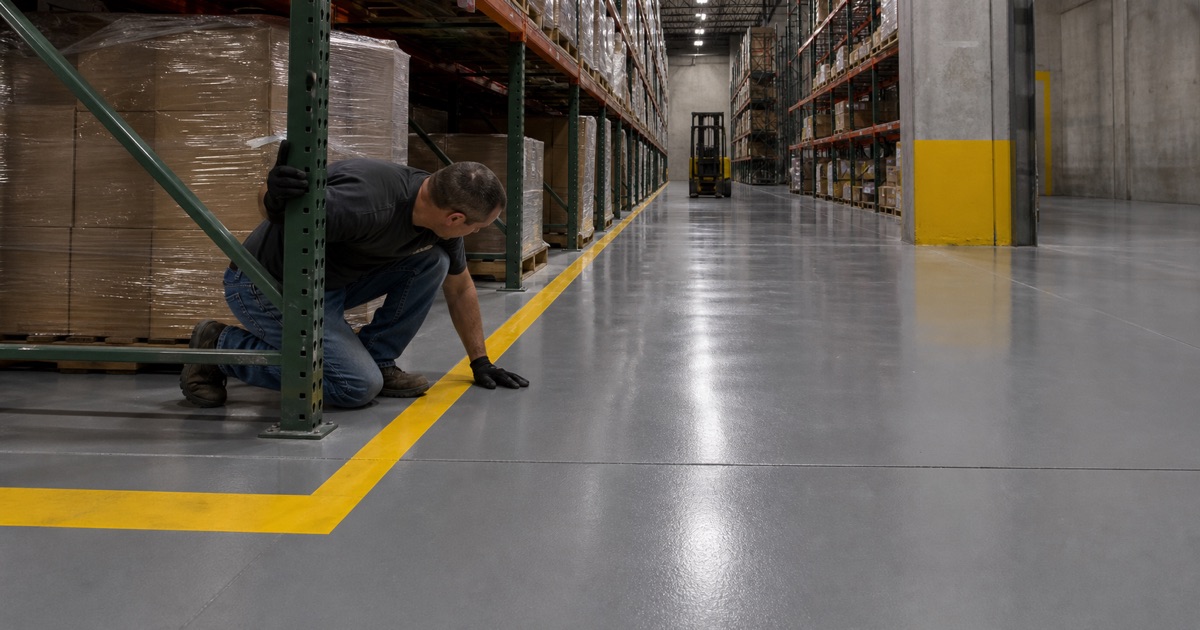
The field of a warehouse floor is rarely what fails; the joints are. A hard forklift wheel crossing an unsupported joint edge chips it, and once an edge starts to break down the damage compounds every pass. We fill joints with a semi-rigid polyurea that carries load right to the edge, build the coating to a mil thickness matched to the traffic rather than to a catalog default, and detail around rack base plates and equipment pads instead of coating over them. Aisle markings, traffic lanes and safety striping go into the system between coats so they sit under the wear layer and do not need repainting every year.
Commercial Kitchens Under the Texas Food Establishment Rules
Texas adopts the FDA Food Code 2017 by reference through 25 TAC Chapter 228, and section 6-101.11(A) is the clause requiring floor surfaces to be smooth, durable and easily cleanable, with section 6-201.13 covering coved floor and wall junctures. We install an integral coved base formed as part of the floor system so there is no seam at the wall for soil and water to collect in, carry the coating properly into drains and under equipment curbs, and specify a build that survives daily washdown. Where an inspector or an operator objects to a textured surface, section 6-201.11 writes the exception itself, permitting antislip floor coverings and applications used for safety reasons.
Automotive, Truck and Equipment Service Bays
A service bay lives with motor oil, coolant, brake fluid, battery acid, dropped tools and steel jack stands, and it is wet with something most of the day. We build these floors with a chemical-resistant 100% solids epoxy at a genuine mil build, choose the topcoat against the specific chemistry the shop handles rather than a general-purpose clear, and broadcast enough texture that the floor is still safe once something has been spilled. Where solvents or acids are stored or decanted, secondary containment flooring gets specified as its own system with its own curbs and falls.
Specialty Systems for Demanding Environments
Static-Dissipative and ESD Flooring
Electronics assembly, semiconductor work and precision manufacturing need a floor with a controlled electrical resistance, not an insulating one. The system is built as a conductive primer over the prepared slab with a grounded copper grid laid into it, then a resin body coat formulated to hold a specified resistance range. The critical difference from ordinary flooring is that the installed floor is measured against that range rather than assumed to meet it, and the readings are handed over as part of the closeout package.
Urethane Cement for Thermal Shock and Hot Washdown
Where a floor takes steam cleaning, boiling spill, hot washdown or freezer traffic, an epoxy will eventually come off the slab regardless of how well it was installed, because resin and concrete expand at very different rates and thermal shock exploits the difference. Urethane cement has a coefficient of thermal expansion far closer to concrete’s own and is placed thick, which is why it is the standard specification in commercial kitchens, breweries, dairies and food processing. It costs more per square foot and it is the cheaper answer over the life of the floor.
Chemical-Resistant and Secondary Containment Systems
Laboratories, plating operations, battery rooms and chemical storage need a floor selected against a specific exposure list rather than against a general claim of chemical resistance, because a system that shrugs off one acid can be destroyed by another. We ask for the actual list of what will be on the floor, match a system to it from published resistance data, and build containment areas with coved curbs, falls to a collection point and a coating carried continuously up every vertical surface.
Working Inside a Live Business
Phased Installation and Shutdown Windows
Most commercial floors go in around a business that cannot simply close. We split the area at joints or saw lines so each section stands on its own, sequence the phases against your operation rather than against our convenience, and match the seams into the layout so the finished floor does not read as a series of patches. It costs more time than a single continuous installation because every phase carries its own edge preparation, containment and cure window, and we price that openly at the estimate rather than discovering it in week two.
Dust, Containment and Odor Control
Grinding and shot blasting generate a great deal of dust, and resin systems have an odor while they cure. We run vacuum-integrated equipment and containment barriers so the work stays inside its area, and we plan ventilation and extraction with you before the first day, particularly where food is stored, where a cleanroom adjoins the work, or where staff will be in the building. On occupied sites this is usually the detail that decides whether the job is tolerable, and it belongs in the plan rather than in an apology.
Submittals, Documentation and Handover
Before work starts we submit product data sheets, safety data sheets, the coat-by-coat system build and the finished mil thickness, along with cure and return-to-service times so your schedule can be built on real numbers. At handover you get what actually went down, recorded against the areas covered, plus any test readings the system called for. A specification you can audit afterward is the point: it is what lets a facilities manager verify a floor rather than trust it.
Preparation and Scheduling on a Commercial Slab
Moisture Testing on Slabs of Any Age
Vapor drive is the most common cause of a large commercial floor failing wholesale, and it does not correlate with the age of the building. We test with ASTM F1869 calcium chloride and ASTM F2170 in-situ relative humidity probes, read against ASTM F710 thresholds, and where a slab was poured over a compromised or absent ASTM E1745 vapor retarder we specify a moisture-mitigation primer as a line item in the quote. On a twenty thousand square foot floor this is the single test most worth paying for.
Mechanical Preparation at Commercial Scale
Every slab is opened mechanically, with ride-on shot blasters for open areas and diamond grinders for edges, corners and around equipment, taken to an ICRI CSP profile matched to the system thickness. We never acid etch and we never coat over an existing sealer or a failing film. Old coatings are removed with PCD tooling first, and we sound the slab for delamination before quoting so that unsound concrete is dealt with as resurfacing rather than discovered mid-installation.
Slab Temperature, Dew Point and the Working Day
The application rules do not relax because a job is large. Epoxies are published for a substrate range topping out near 100 degrees, and a slab behind a roll-up door on a Central Texas afternoon reaches that well before the air does, while dew point at the slab surface closes the early morning. On summer work we start mid-morning and finish before the slab loads, and where a schedule cannot accommodate that we say so at tender rather than compromising the floor to hold a date.
- 20+ Years in Central Texas
- Insured & Workers Comp Covered
- Free Written Estimates