
Pflugerville Epoxy Flooring provides concrete grinding across Pflugerville, TX and the surrounding cities including Wells Branch, Round Rock, Manor, Hutto and Brushy Creek, and after more than 20 years of it we will say something most flooring companies would rather not: this is the part of the job that decides whether the floor lasts, and it is the part customers are most often asked to pay less for.
Concrete grinding is surface preparation. It removes coatings, adhesives, curing compounds and the closed, burnished skin left by a power trowel, and it leaves behind an open, mechanically keyed profile that a coating can actually grip. Every resin system on this site relies on it, and no product on the market compensates for its absence. A coating on an unprepared slab is held on by nothing but hope.
We also grind as a standalone service. Contractors, property managers and homeowners bring us slabs that need a coating stripped, a trip hazard taken down, adhesive removed after a floor covering comes up, or a surface flattened before something else is installed. Whether it is preparation for our own work or for somebody else’s, the standard is the same.
What Concrete Grinding Is For
Removing Coatings, Sealers and Curing Compounds
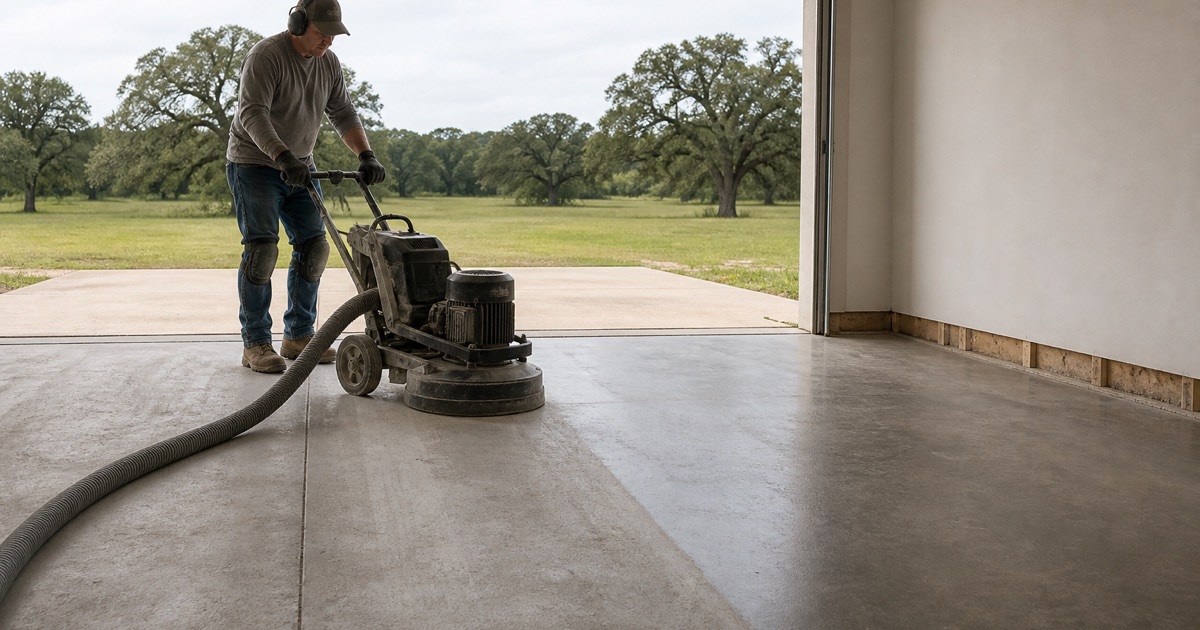
Anything sitting on top of your concrete has to come off before anything new goes on. Failed epoxy, garage floor paint, acrylic sealer and the curing compound sprayed on the day the slab was poured all prevent a bond, and none of them can be seen reliably by eye. We use PCD tooling to break up thick or well-bonded films, then follow with diamonds to clean up and profile, moving to a shot blaster where the area is large and open.
Adhesive, Mastic and Thinset Removal
When carpet, vinyl or tile comes up, the covering is the easy part and what it was stuck down with is not. Carpet adhesive and mastic are soft and gummy, and they load and glaze conventional diamond tooling within minutes. PCD tooling shears them off instead, and we follow with a grinding pass to bring the concrete back to a uniform surface. Thinset from tile is the opposite problem, hard and uneven, and it needs aggressive metal-bond diamonds.
Flattening, Trip Hazards and High Spots
Grinding takes down what stands proud: a lipped joint, a slab edge that has heaved, a trowel ridge, a high point that a new floor covering would telegraph. We can bring a localized high spot flush or flatten a whole area to a tolerance where a subsequent installation requires it. There is a limit worth knowing, which is that grinding removes material and cannot add any, so a low area is a patching job rather than a grinding one.
Profile, Tooling and Getting It Right
ICRI CSP Profile and Matching It to the System
The concrete surface profile scale from ICRI runs from barely textured to heavily roughened, and the right target depends on what is going on top. A thin sealer wants a light profile, a standard coating system wants a moderate one, and a thick overlay or urethane cement wants a deep one because it needs mechanical anchorage proportional to its own thickness. We choose the profile from the system specification rather than grinding everything the same and hoping it suits.
Diamond Segment Bond Hardness
This is the technical detail that separates a crew that grinds from a crew that owns a grinder. Diamond bond hardness has to be matched inversely to concrete hardness: a soft bond wears away fast enough to keep exposing fresh diamond on hard concrete, and a hard bond survives long enough to be economic on soft concrete. Get it backwards and the tooling either glazes and stops cutting or disappears in an hour. We bring more than one bond to a slab we have not ground before.
Why We Never Acid Etch
Acid etching is sold as a preparation shortcut and it is a poor one. It barely touches a hard power-troweled surface, it leaves salts behind that must be neutralized and thoroughly rinsed, and it introduces a large volume of water into a slab immediately before you need that slab dry. It also cannot remove a coating, a sealer or adhesive. Mechanical preparation does all of those things at once and leaves a measurable profile rather than an uncertain one.
How We Work on Your Site
Dust Control and Containment
Dry grinding concrete produces an enormous quantity of very fine dust, and it is silica, so it is a health matter rather than a housekeeping one. We run vacuum-shrouded equipment with HEPA-rated dust extraction and put up containment where the area adjoins occupied space. On an occupied commercial site we agree the containment plan and the extraction route before the first day, because that is usually what determines whether the work is tolerable for everyone else in the building.
Edges, Corners and Around Equipment
A ride-on or walk-behind grinder cannot reach the last few inches against a wall, into a corner, or around a column or an equipment base, and an unground perimeter is exactly where a coating starts to lift. Edge grinders and hand tools take those areas to the same profile as the field. It is slow, unglamorous work and skipping it is one of the most common defects we find when we are called to a floor somebody else installed.
Grinding as Preparation for Someone Else’s Installation
We are happy to grind for other trades. If you are installing your own coating, laying a new floor covering, or you have a contractor who needs a slab prepared to a specified profile, we will do that as a standalone job and hand it over clean, vacuumed and ready. Tell us the system that is going on top and we will grind to its profile requirement rather than to a generic one.
- 20+ Years in Central Texas
- Insured & Workers Comp Covered
- Free Written Estimates